
01
Four stages, one honest answer.
The output is a roadmap you could hand to another partner. That is deliberate — advice you can only act on with us is not advice.
Request a consultation
AI Consultation
Four weeks, your own data, and an honest answer — including about what not to automate.
How it runs
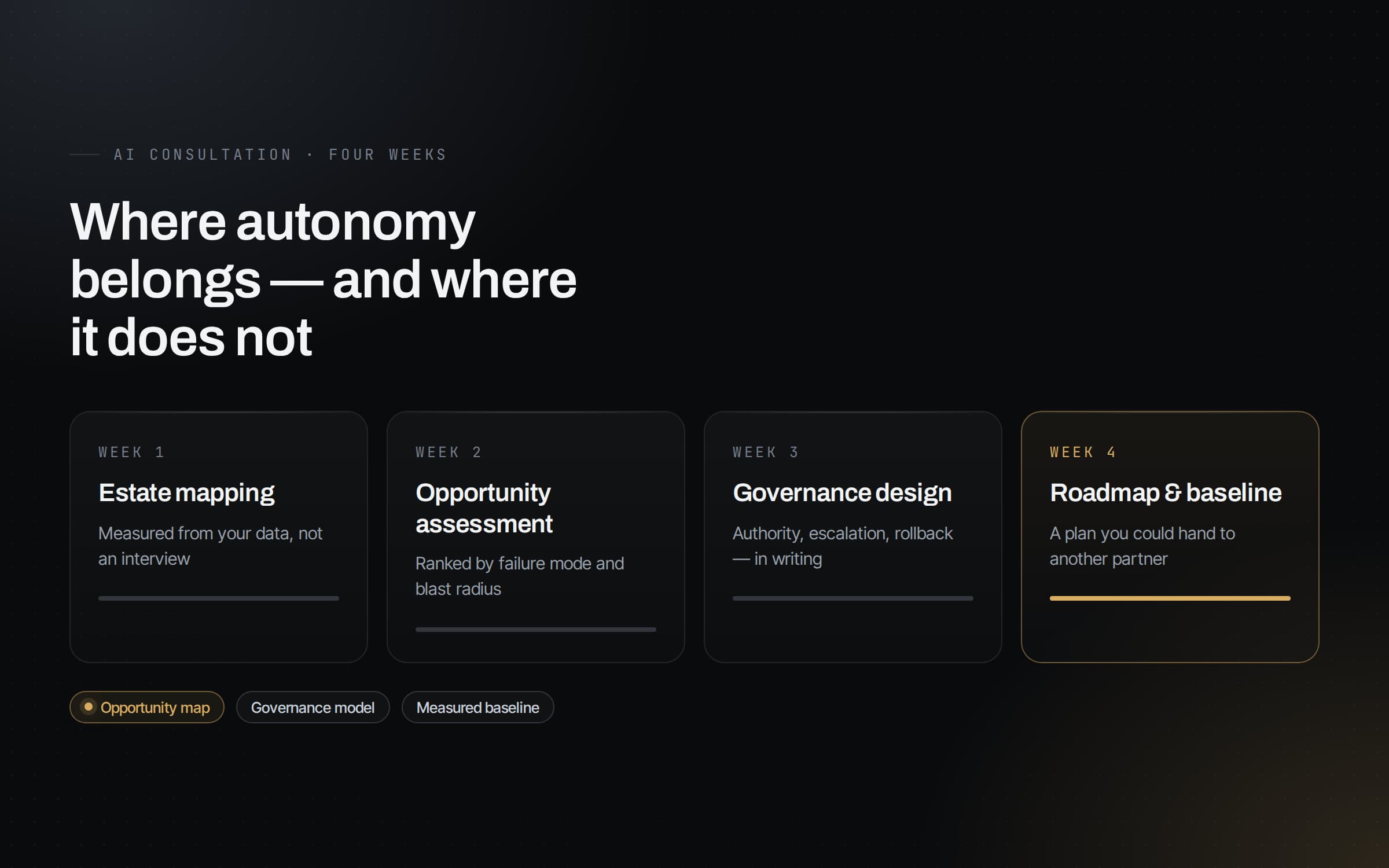
Systems, dependencies, telemetry quality and where operational effort actually goes — measured from your data rather than from an interview.
Which classes of work are candidates for autonomy, ranked by understood failure modes and blast radius rather than by potential saving.
The authority boundary, escalation paths, evidence retention and rollback strategy — written down before anything is built.
A sequenced plan with the measurement agreed up front, and a clear statement of what should stay in human hands.
What you leave with
Ranked candidates for autonomy across your estate, with the reasoning behind the ranking and the data it came from.
Authority boundaries, escalation design, evidence and retention — the document your risk function will ask for.
What today actually costs, agreed with your team, so improvement can be demonstrated rather than asserted.
FAQ
Four stages. We map your estate, assess which kinds of work are ready for autonomy, design the governance around it, and agree a roadmap with a measured baseline. Each stage is written down before anything is built.
An opportunity map that ranks candidates for autonomy and explains why, a governance model your risk team can review, and a measured baseline of what today's work costs. Together they show what to do first and how to prove it worked.
No. The work starts from how your operations run today, measured from your own data. The point is to find where autonomy belongs, and where it does not, before any tool is chosen.
Engineers who have built the kind of systems they are advising on. That keeps the roadmap grounded in what can be delivered, not only in what looks good on a slide.
Bring your ticket history, your telemetry and the operation that costs the most attention. Four weeks later you will know exactly where to start — and where not to.